
Weekly Market Roundup
04-May-2026
MettisGlobal
May 01, 2026 (MLN): Pakistan’s equity market extended its decline during the week ended
May 01, 2026, with the benchmark KSE-100 Index closing at 162,994.17, down
sharply from 170,672.04 recorded on April 24, 2026.
The index plunged
7,677.87 points, translating into a 4.50% week-on-week (WoW) decline,
marking an acceleration in selling pressure after the previous week’s
correction.
Investor sentiment
is likely to remain sensitive to geopolitical tensions and developments in
global risk appetite, which may continue to drive volatility in the market._20260501105037204_132b46.jpeg)
Market Capitalization
Total market
capitalization declined significantly in line with the index performance. As of
May 01, 2026, market cap stood at Rs4.695 trillion, compared to Rs4.923tr
on April 24, 2026, marking a decrease of Rs228.25bn or 4.64% WoW.
In USD terms, market
capitalization fell to $16.84bn from $17.65bn in the previous
week, reflecting a notable erosion in overall market value._20260501105020799_1a094a.jpeg)
Dollar-adjusted
returns remained firmly negative, clocking in at -4.47% WoW, compared to
-1.85% in the prior week, indicating a sharp deterioration in investor
returns in both local and foreign currency terms amid intensified market
correction.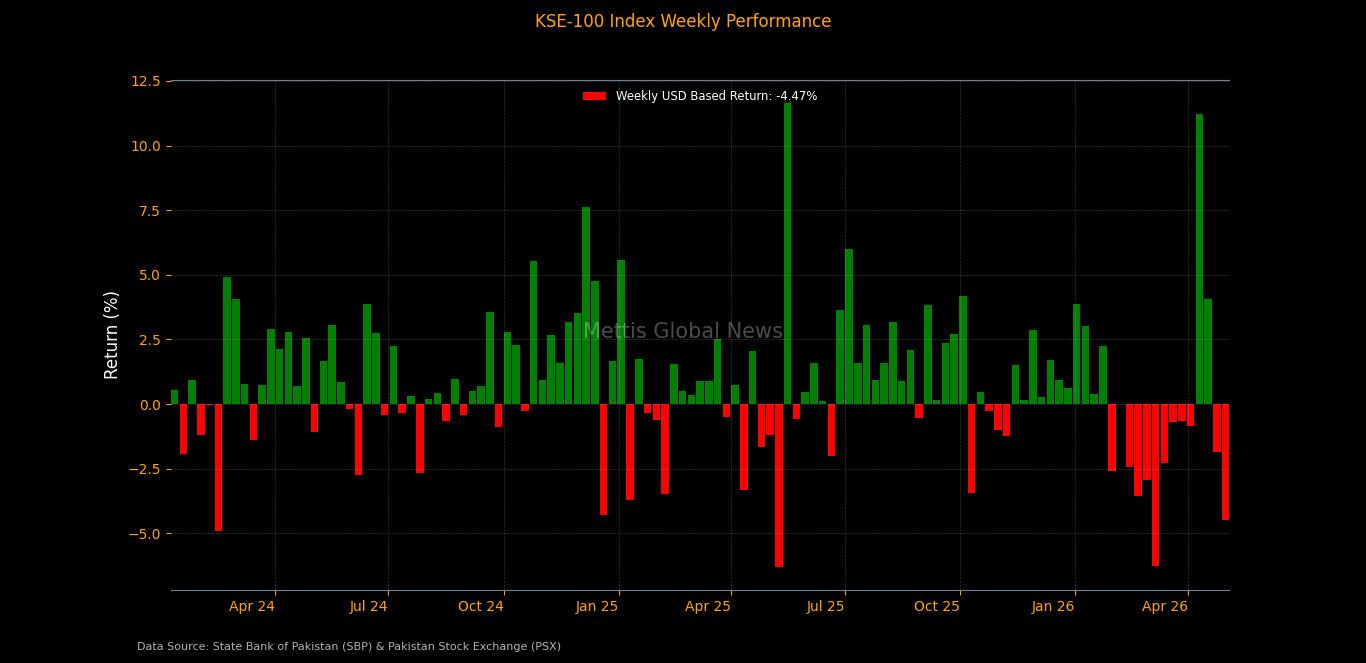
On the macroeconomic
front, the State Bank of Pakistan raised
through its Market Treasury Bills auction on April 30, 2026, driven by strong
demand across short-term tenors.
However, it rejected all bids in the 10-year floating-rate
Pakistan Investment Bond auction, resulting in zero mobilization from the
long-term instrument.
Pakistan’s total money in March 2026, showing a 2.2% MoM and 13.57% YoY
increase, driven mainly by higher currency in circulation and deposit growth.
The uptick highlights continued cash demand amid
inflationary pressures, with currency in circulation posting a notable 16.29%
annual rise.
The State Bank of Pakistan from the interbank market in January 2026, lower than December’s
$1.02bn but significantly higher than $154m a year ago, showing improved inflow
conditions despite a slight monthly moderation.
The State Bank of Pakistan raised its policy rate by 100
basis points to in
April 2026, marking the first increase in nearly three years, as rising
inflation and higher fuel prices worsened the inflation outlook.
The move reflects a shift toward tighter monetary policy,
with the MPC aiming to anchor inflation expectations amid geopolitical risks,
fiscal pressures, and mounting external uncertainties.
Index Movers
Sector-wise, the decline remained heavily concentrated in index-heavy sectors.
Commercial banks
emerged as the largest drag, shaving off 2,576.60 points, followed by
oil & gas exploration companies (-1,272.13 points), highlighting
pressure on major index drivers.
Cement contributed a
decline of 782.71 points, while fertilizer (-684.36 points) and
oil & gas marketing companies (-368.93 points) further weighed on
the benchmark.
Technology &
communication (-337.05 points) and power generation & distribution (-320.10
points) also remained under pressure, reflecting widespread selling across
cyclical and growth sectors.
Other notable
negative contributors included investment banks/securities (-304.21 points),
pharmaceuticals (-246.92 points), and property (-103.58 points),
reinforcing the broad-based nature of the downturn.
On the positive
side, limited support came from tobacco (+21.13 points) and automobile
assemblers (+19.42 points), along with marginal contributions from sugar
and modarabas, indicating selective resilience in a weak market.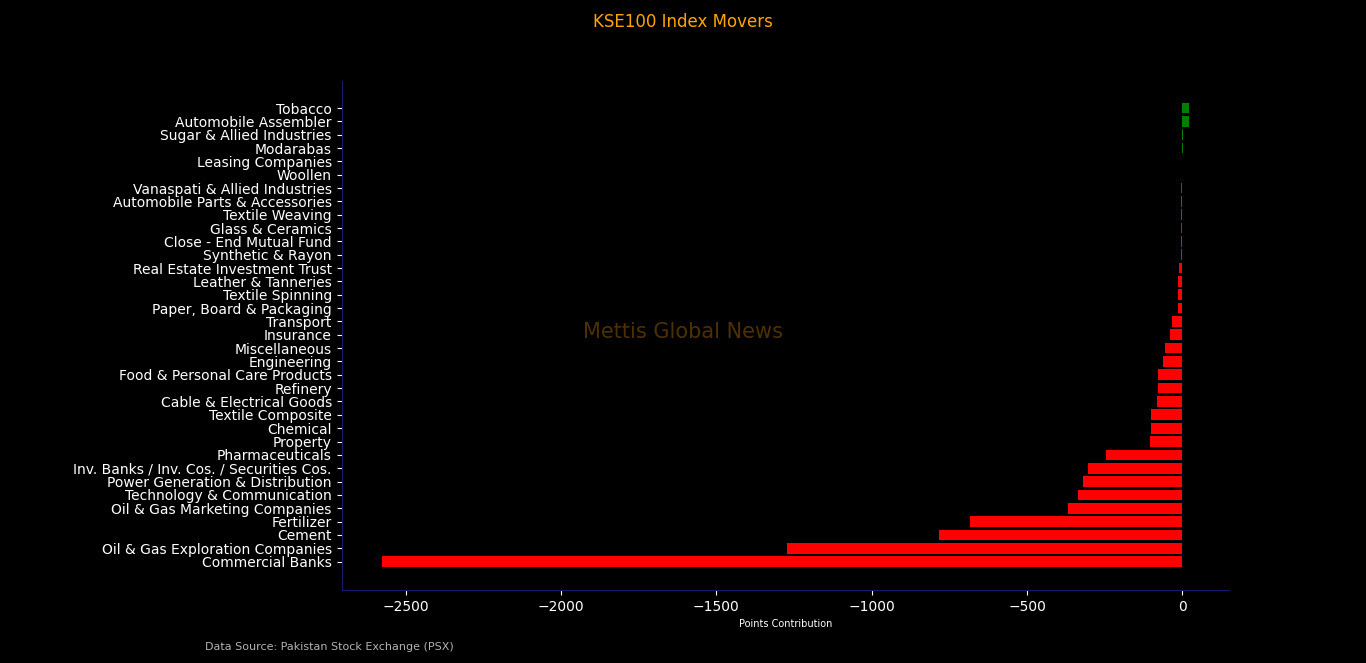
Scrip-wise, the downside was dominated by heavyweights.
United Bank Limited
led the decline, dragging the index by 1,066.79 points, followed by
National Bank of Pakistan (-663.04 points) and Pakistan Petroleum
Limited (-589.15 points).
Other major laggards
included Fauji Fertilizer Company (-562.54 points), Oil and Gas
Development Company (-508.75 points), and Lucky Cement (-339.45
points).
Additional pressure
came from Pakistan State Oil, Engro Holdings, Hub Power Company, Habib Bank
Limited, Mari Petroleum Company, and MCB Bank Limited, reflecting heavy selling
in banking, energy, and cement stocks.
On the upside, gains
remained limited and largely concentrated in automobile names, with Indus Motor
Company leading the pack (+64.61 points), followed by Honda Atlas Cars and
Millat Tractors.
Other contributors
included Pakistan Tobacco Company, Pakistan Oilfields Limited, and Attock
Petroleum Limited, highlighting selective buying in defensive and auto
segments._20260501104954123_5d4907.jpeg)
FIPI / LIPI
Foreign investment flows showed a modest net inflow during the week.
Under Foreign
Institutional Portfolio Investment (FIPI), overseas Pakistanis remained the key
buyers with a net inflow of Rs1.36bn ($4.86m).
However, foreign
corporates were net sellers, recording an outflow of Rs757.40m ($2.71m),
while foreign individuals posted a marginal inflow of Rs0.14m.
Overall, FIPI
recorded a net inflow of Rs598.42m ($2.14m), indicating slight foreign
support despite broader market weakness.
On the domestic
side, Local Portfolio Investment (LIPI) activity remained mixed.
Individuals emerged
as the largest buyers with a strong net inflow of Rs7.65bn, followed by
companies (+Rs398.93m) and banks & DFIs (+Rs326.39m),
providing liquidity support to the market.
On the flip side,
mutual funds led the selling with a significant net outflow of Rs7.97bn,
while broker proprietary trading (-Rs876.26m) and insurance companies (-Rs176.11m)
also contributed to the selling pressure.
Other participants
remained largely neutral, indicating a cautious stance across institutional
investors.
In the debt
market, activity remained relatively subdued, with individuals showing net
inflows, while mutual funds recorded outflows, reflecting selective
reallocation across asset classes._20260501104956384_d6bc8f.jpeg)
Copyright